
Very low water use
Because water circulates in a closed loop, only losses from evaporation and plant growth need to be replaced. According to the FAO, soil-free cultivation systems use less than 20% of the water required by soil-based farming.
Learn · Aquaponics
Definition
Aquaponics combines two production methods in a closed water cycle: fish farming (aquaculture) and soil-free plant cultivation (hydroponics). The word itself is a portmanteau of both.
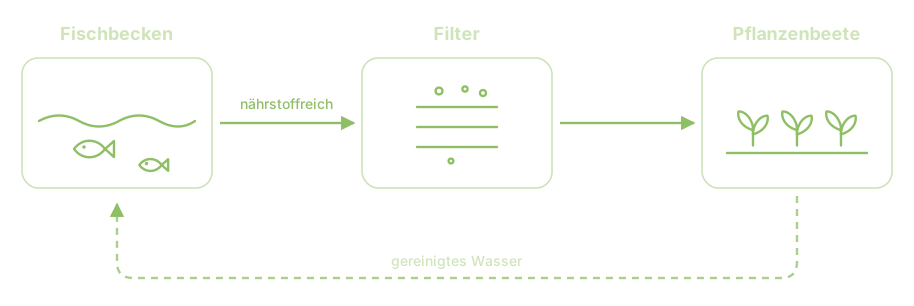
The core principle is symbiosis. Fish enrich the water with nutrients; bacteria convert the ammonia into plant-available nitrate. The plants absorb it and in doing so purify the water, which flows back to the fish. One organism's waste becomes another's resource.
Unlike conventional aquaculture, the water does not need to be regularly exchanged and disposed of. Unlike open-field farming, no fertile soil is needed — and almost no external fertiliser.
Advantages
The strengths of aquaponic systems lie in their resource efficiency and independence from ideal site conditions.
Because water circulates in a closed loop, only losses from evaporation and plant growth need to be replaced. According to the FAO, soil-free cultivation systems use less than 20% of the water required by soil-based farming.
Fish waste replaces a large portion of mineral fertiliser. Nutrients are kept within the system rather than being leached into groundwater.
Because plants root in water, aquaponics works even where soils are degraded, sealed, or absent — for example in urban environments.
In a protected environment such as a greenhouse, yields can be largely stabilised regardless of weather and climate.
Fish and vegetables are produced together on the same area using the same water — an advantage precisely where space and water are scarce.
Aquaponic units can be operated decentrally on-site, reducing dependence on long supply chains.
Application
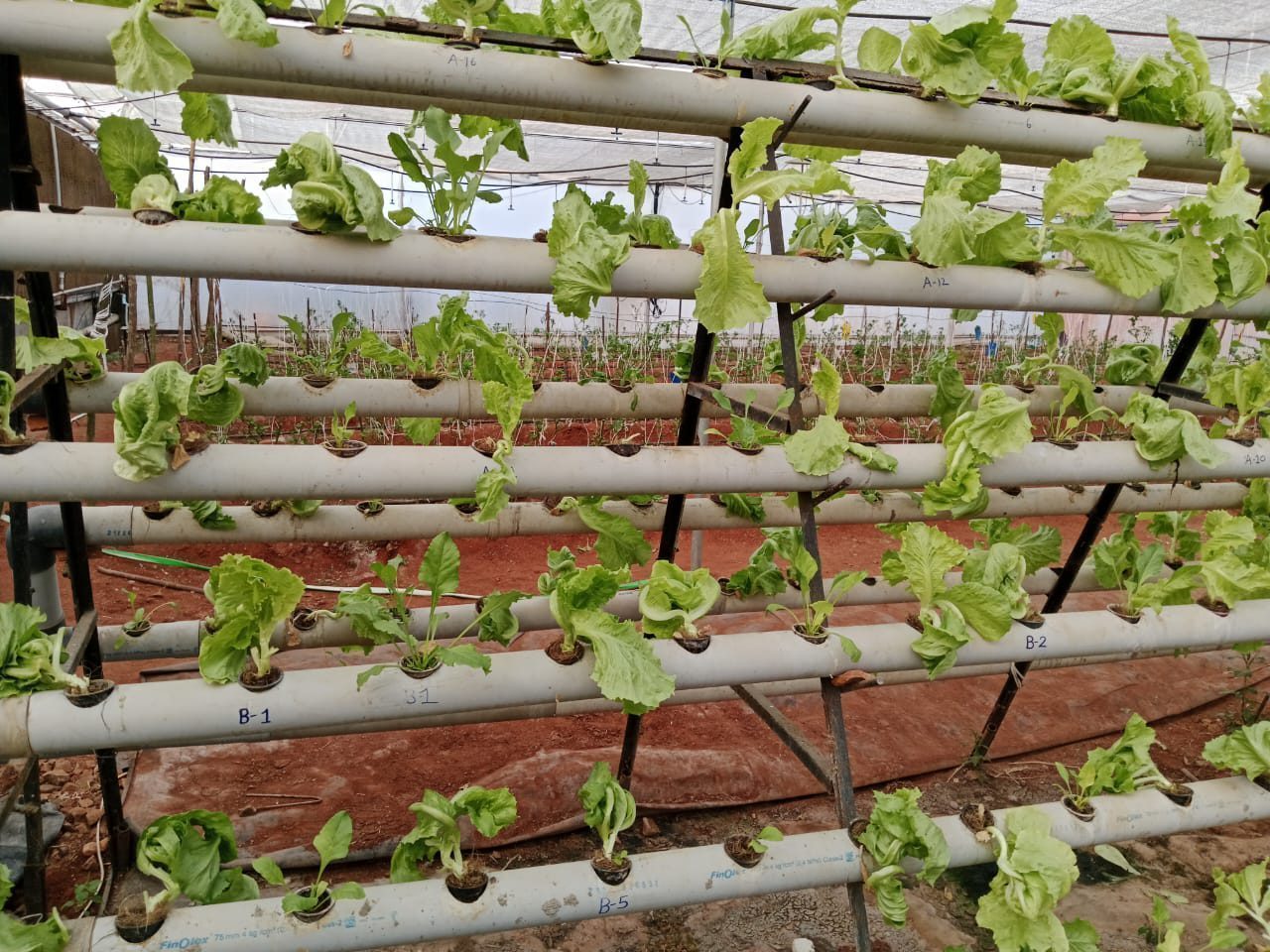
In our system concept Project Oasis, aquaponics forms the productive core. Inside a geodesic dome greenhouse, water passes through several stages: fish tanks, biological filters where bacteria convert nutrients, solid filters, and media beds and NFT channels where the plants grow.
The geodesic dome protects the installation from extreme weather and creates a stable microclimate — allowing the aquaponic cycle to run even in climatically difficult regions, precisely where conventional farming reaches its limits.
We show how this cycle works step by step on the project page, in an interactive model view.
The principle is explained. What's missing are installations that put it into practice where food security isn't guaranteed.
Fish tanks, filters, growing areas: aquaponics requires an upfront investment before it delivers. That's exactly where your donation makes a difference.
Process engineering, aquaculture, horticulture, sensors: a running system needs more competencies than a small team can cover.
Most people are hearing about aquaponics for the first time. Share this page with someone who hasn't yet.